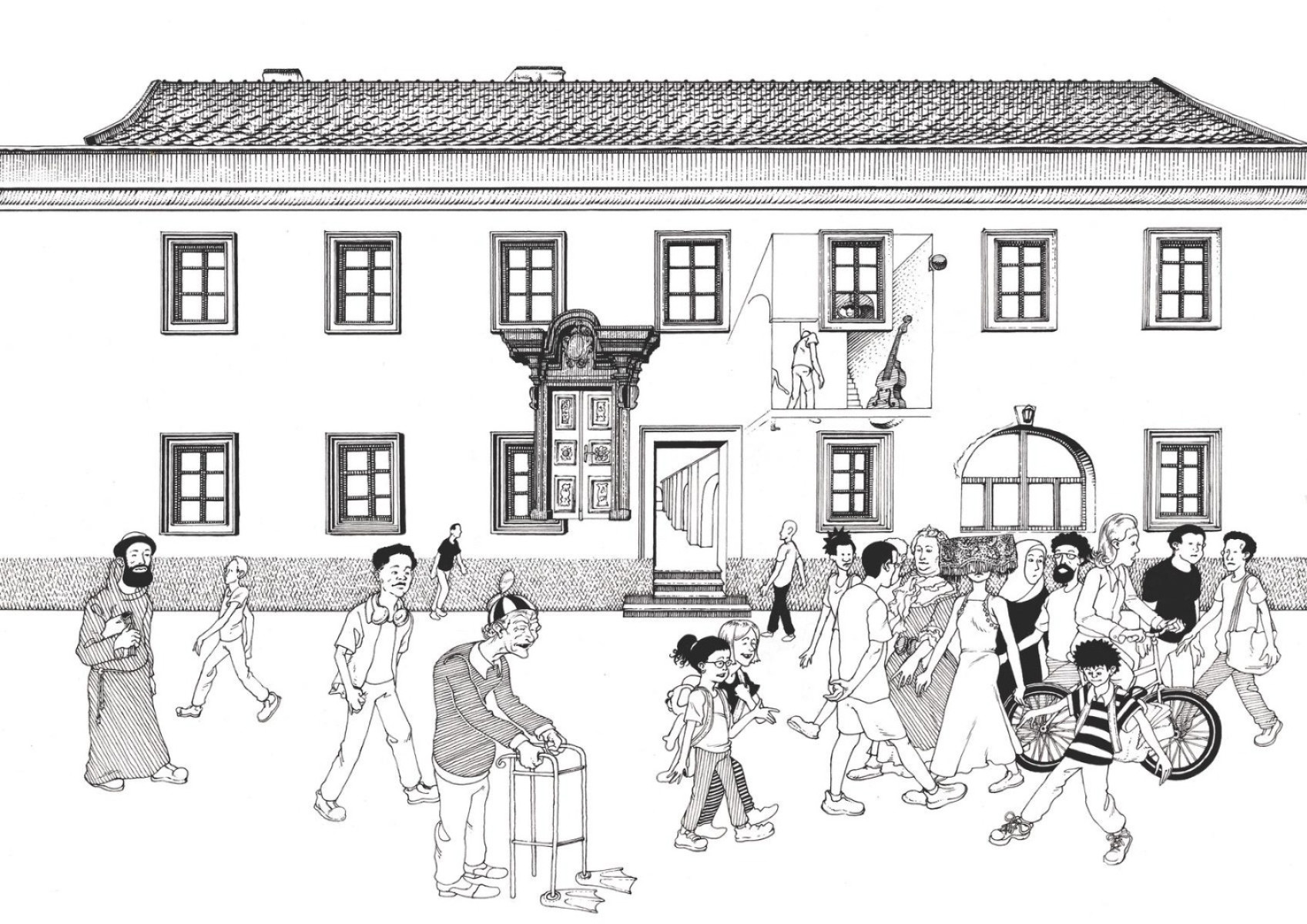
The Bosnian Franciscans were present in Timișoara as early as the Ottoman period, when they were granted a mosque located on the eastern side of today’s Liberty Square. On this site, between 1733 and 1736, they built the Church of St. John of Nepomuk, with the help of Italian craftsmen.
The main altarpiece, completed in 1736, was painted by Michel Angelo Unterberger, who would later also create the main altar painting of the Timișoara Cathedral. The monastic complex was completed in 1761, becoming an important religious and cultural center of the city.
In 1790, the complex was taken over by the Piarist monks, who carried out several renovations and adaptations. Over time, the building acquired a variety of functions: from monastic cloister to Piarist gymnasium, and later to institutions of artistic education—music and fine arts school, conservatory, and even kindergarten.
A turning point came during the siege of 1849, when the entire complex was severely damaged and the church organ destroyed. Restoration works were completed in 1855, but the structural condition of the church continued to deteriorate. In 1901, it was closed for safety reasons, and in 1911, due to the high costs of restoration, it was demolished. The Piarists then moved to their new complex in what is now Regina Maria Square.
While the church disappeared, the cloister survived and continued to be reused, constantly adapting to the needs of the city. The façade has lost most of its original Baroque decoration; only simplified profiles around the windows and cornice remain visible today.
A small but powerful detail can be found between the second and third windows on the upper floor (counting from right to left): an artillery cannonball embedded in the wall, fired during the 1849 siege. It stands as a silent witness to the violence of that moment and the building’s endurance.
The site also preserves the memory of notable individuals. The remains of Karl von Greth, former commander of the fortress, his wife Johanna (Jeannette) von Honrath—known as the first love of Ludwig van Beethoven—as well as those of councillor David von Hübner and his wife Anastasia, were originally buried here and later moved to the Heroes’ Cemetery. Two of their epitaphs can still be seen today on the cemetery’s fence.
Today, the cloister of the former Franciscan Monastery houses the Timiș County Centre for Culture and Art, continuing—albeit in a contemporary form—its long-standing role as a space dedicated to the community. Although the church has disappeared, the site remains an urban palimpsest, where religious, educational, and cultural layers continue to coexist.