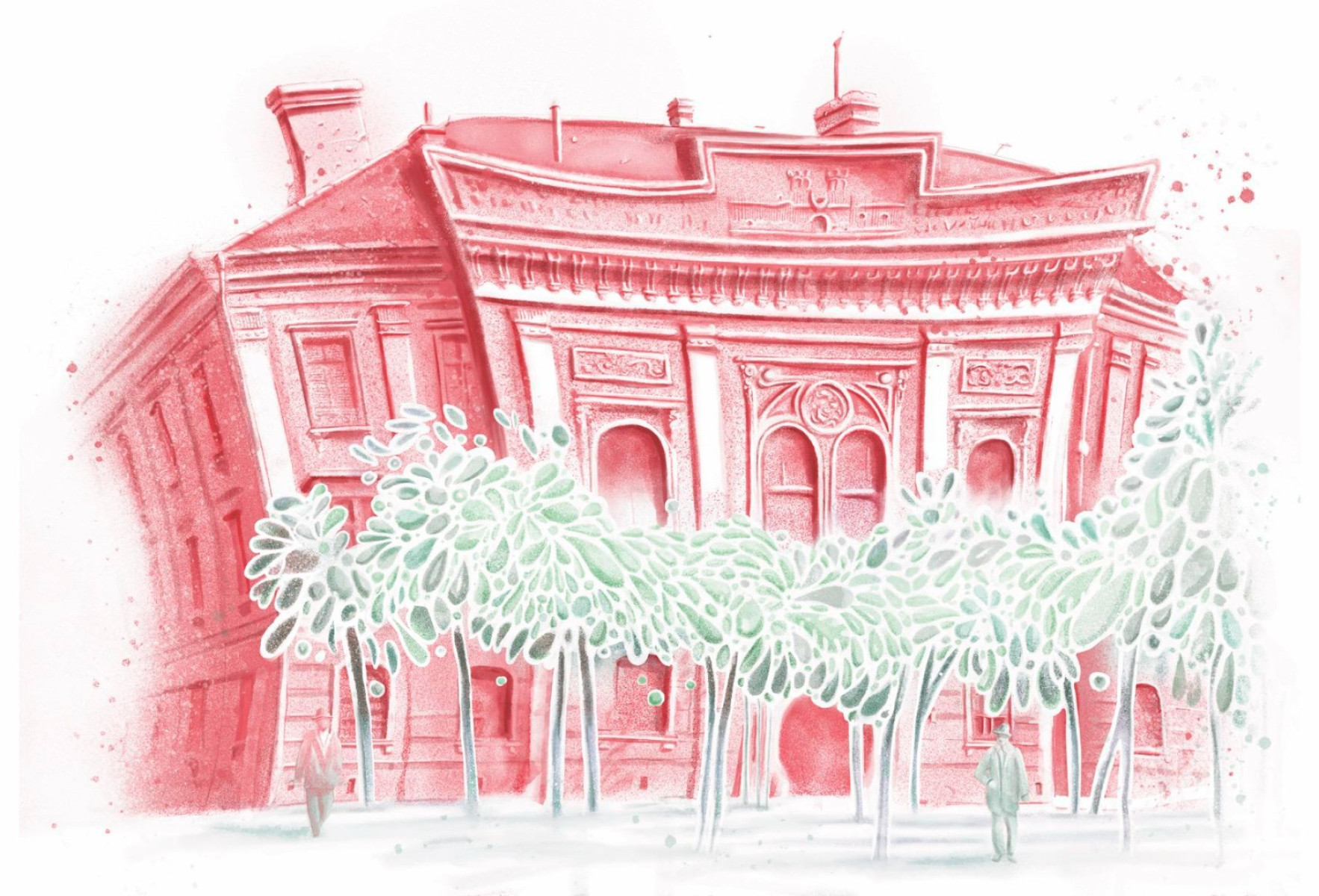
The building at Liberty Square no. 1 is the result of the merging of two historical plots, originally developed independently along Vasile Alecsandri Street and Emanoil Ungureanu Street. Its evolution reflects, in miniature, the administrative, social, and urban transformations of Timișoara.
On the eastern side, facing Vasile Alecsandri Street, a building is documented as early as 1727. By 1731, it was known as “At the Two Golden Keys” (Haus zu den zwei goldenen Schlüsseln), likely functioning as an inn or a commercial building. In 1752, the structure was completely rebuilt, and its owner, Stephan Callinovich, hosted the War Chancellery on the upper floor, marking the beginning of its administrative use.
Throughout the 19th century, the civilian part of the building passed through several owners, while administrative functions persisted. The War Commissariat operated here, and around 1900, the ground floor housed the “Uhrmann Henrik” stationery shop, reflecting a diversification of uses.
At the same time, on the western side, towards Emanoil Ungureanu Street, the administrative core of the ensemble took shape. An initial project was drafted in 1724, attributed to an Italian architect (possibly Fortunato da Prati). Between 1731 and 1734, the building was constructed based on a project attributed to the architect Pietro del Bonzo, combining multiple functions: town hall, ballroom, tavern, and shop. Between 1734 and 1781, it served as the Town Hall of the German Community, and from 1781 it became the seat of the Town Hall of the Free Royal City of Timișoara. The building was reconstructed in 1782, based on a project attributed to architect Joseph Aigner.
Over time, the two structures were integrated into a single ensemble. By 1911, the building functioned as the Town Hall of the Free Royal City of Timișoara, and around 1935 a major intervention likely resulted in the unified façade visible today.
Following the transformations of the 20th century, the administrative function gradually disappeared, replaced by a mix of commercial and institutional uses. In 2012, the ground floor hosted various services, including a minimarket, pharmacy, barbershop, and public institutions.
Today, the building houses the Faculty of Music and Theatre of the West University of Timișoara, continuing—albeit in a different form—its long-standing role as a public and community-oriented space. From a place of administration and everyday urban life, it has become a space for artistic education, preserving within its layers the memory of the city.